Capabilities
Company and project overview
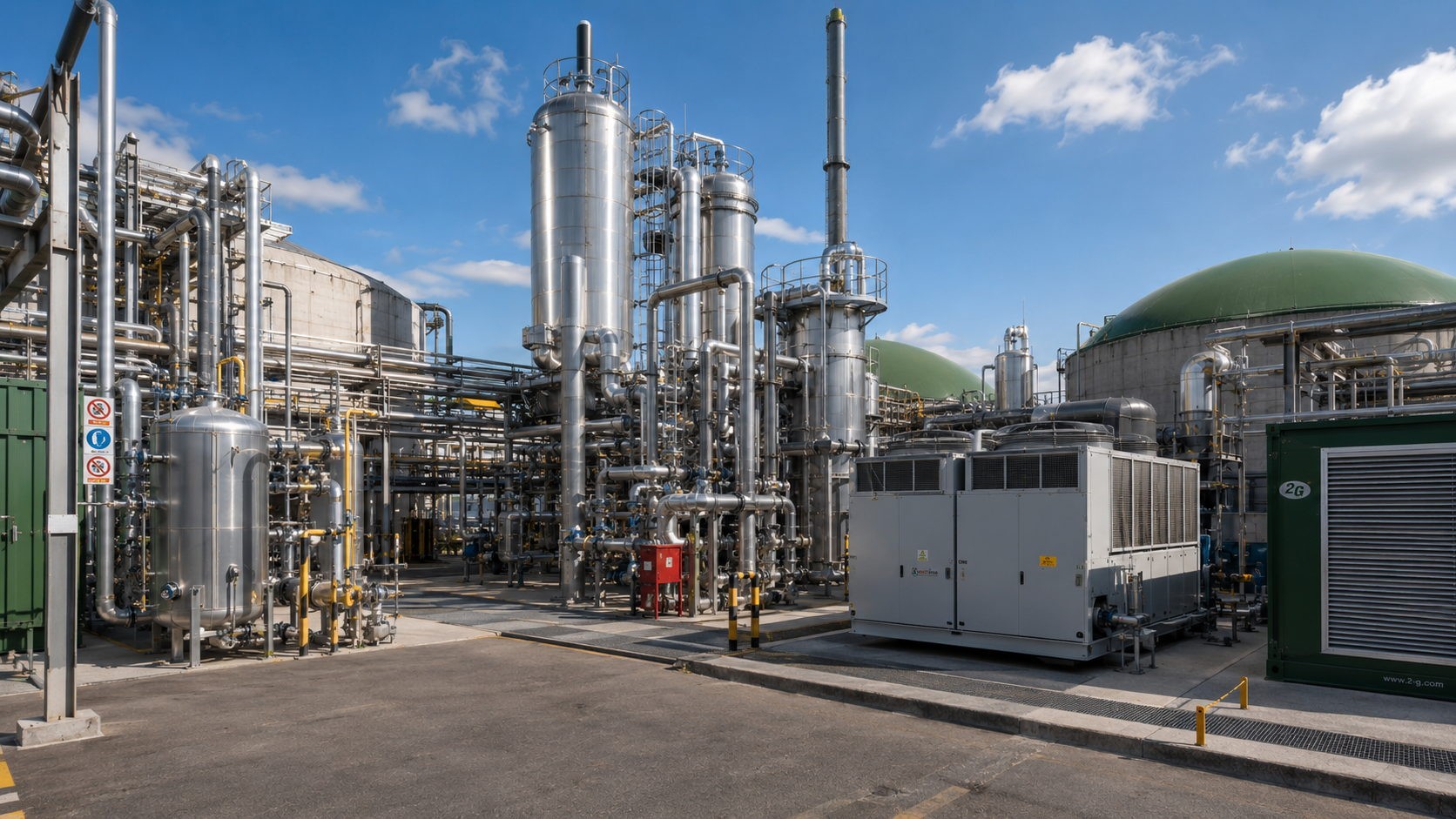
Algae & Algae Società Agricola r.l. is developing an integrated circular-economy platform near Mesagne in Brindisi province, Puglia. A controlled mix of agricultural and agro-industrial materials will be converted into pipeline-quality biomethane. The same process separates a recoverable CO₂ stream and retains nutrients and organic matter in stabilised digestate.
Site and grid access
- Owned development platform: 32 hectares in Mesagne, Brindisi.
- Direct grid pathway: the SNAM high-pressure trunk pipeline crosses the property.
- Local resource base: agricultural and agro-industrial supply relationships support the feedstock model.
- Agricultural route: nearby farming demand provides a natural market for finished digestate.
Diversified feedstock strategy
The planned recipe can combine olive pomace and olive-processing residues, fruit and vegetable residues, tomato skins and other food-processing residues, cattle manure, silage agricultural biomass, and flour-processing waste within biological, contractual and regulatory limits. Executed contracts cover the first five operating years, while cooperative frameworks provide a potential supply buffer of approximately 25% above project requirements.
Integrated process
- Receive: inspect, weigh and store approved feedstocks.
- Prepare: blend and condition the recipe for stable digestion.
- Digest: convert organic matter into methane-rich raw biogas.
- Upgrade: remove trace compounds and separate carbon dioxide.
- Deliver: compress biomethane, purify and liquefy CO₂, and finish digestate for agricultural use.
Management-case outputs
- Biomethane: 13 million Sm³/year saleable output; modelled steady-state revenue of approximately €17.41 million.
- Recovered CO₂: 18,000 tonnes/year; modelled steady-state revenue of approximately €1.17 million.
- Enriched digestate: 50,000 tonnes/year; modelled steady-state revenue of approximately €2.75 million.
Biological and gas-processing pathway
Anaerobic digestion follows the established hydrolysis, acidogenesis, acetogenesis and methanogenesis pathway. The operating concept uses controlled feedstock acceptance, recipe management, temperature, residence time and mixing; three primary digesters and three gas-recovery tanks form the methane-generation circuit. Raw biogas is expected to contain approximately 52–57% methane before cleaning and upgrading.
Gas cleaning controls hydrogen sulphide, moisture and nitrogen compounds. CO₂ is separated for purification and liquefaction, while the remaining methane stream is compressed and confirmed against the applicable grid specification before SNAM injection. Planned recovered-CO₂ markets include food and beverage processing, refrigeration and industrial users.
Digestate and circular agriculture
Digestate retains organic matter and plant nutrients after biogas production, including nitrogen, phosphate, potash and micronutrients. The proposed finishing route is designed to create a consistent agricultural input through six controlled stages: digest, separate, stabilise, enrich, control and apply.
Product commercialisation is structured around four safeguards: legal classification and documented specifications; nutrient analysis and agronomic planning; feedstock, process and laboratory quality controls; and transparent guidance on storage and application.